
Sunset on Utah Lake: A Portrait of Saratoga Springs
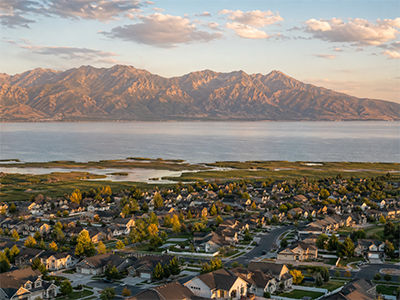
April 28, 2026 — Saratoga Springs, UT From the eastern bench at sunset, Saratoga Springs looks engineered for the postcard. The Wasatch Range catches the last sun and turns the color of sandstone. Utah Lake goes glassy and pewter. Roofs of new subdivisions march toward the shoreline in tidy curves, and the western sky burns through reds and oranges that don’t really exist anywhere else in the country. This is a city that didn’t exist, in any meaningful sense, twenty-five years ago.
A City Born From a Lake
Saratoga Springs was incorporated on December 30, 1997, when the lakeshore was still mostly farmland and warm springs. The springs themselves — bubbling up along the lake edge for thousands of years — had been a Ute gathering place, then the site of Beck’s Saratoga Springs resort in the late 1800s, then quiet again for most of the 20th century. By the time the city incorporated with fewer than 250 residents, Utah County was beginning the long boom that would reshape it, and the empty acres on the lake’s northwest shore turned out to sit exactly where growth wanted to go.The Lake Is the Main Character
Most American boomtowns are organized around a highway exit or a tech campus. Saratoga Springs is organized around water. Utah Lake — the largest natural freshwater lake in Utah — defines the city’s southern and western edge. From most neighborhoods you can see it. From many you can walk to it. The marina hosts paddleboards and small sailboats; the shoreline trail runs for miles; sunsets over the lake are the dominant evening event for residents who actually pay attention. It’s worth saying out loud that this is unusual. There are very few American suburbs in which a major lake is part of daily life. In Saratoga Springs, it’s the answer to the question of what makes the city different from any other Wasatch Front bedroom community.The Growth Story
The numbers are striking. From a population of about 1,000 in 2000 to nearly 18,000 in 2010 to roughly 38,000 in 2020 — and an estimated 52,000 today — Saratoga Springs has been the fastest-growing city in Utah for a stretch of years that most cities never see. The Utah Governor’s Office of Economic Development clocked its growth from 2000 to 2010 at over 1,600 percent. The city’s master plan continues to absorb new subdivisions on the western and northern flanks. New schools open every few years. The transition out of Alpine School District — voters approved the split in 2024, and a new Lake Mountain School District covering Saratoga Springs, Eagle Mountain, Fairfield, and Cedar Fort is in formation — reflects the same forces. The cities west of the lake are simply too big and too distinct from American Fork or Lehi to keep sharing administrative DNA.What the View Holds
From the right vantage at sundown, you can see the entire ecology of the place at once. In the foreground: a subdivision laid out in arcs, garages still warm, lights coming on one by one. In the middle: marshland and wetland, the edge where Utah Lake breathes in and out with the seasons. Behind that, the lake itself, holding the sky. And behind the lake, the Wasatch Range — a wall of rock that turns gold, then pink, then violet over the course of about ten minutes. It’s the geological equivalent of a nested doll. The mountains were here first, then the lake, then the marsh, then the subdivisions. Each one is younger than the one above it and dependent on the ones below.The People Who Choose This
Drive through Saratoga Springs on a weekday evening and you’ll see the typical signs of a young family town — bikes in driveways, jogging strollers on the lakeshore trail, soccer practices clogging the park lots. The residents skew younger than the Utah average, and a lot of them work in Lehi at one of the Silicon Slopes companies; others commute to Salt Lake County or work remotely from spare bedrooms with a lake view. What they have in common is that they chose this place over the older, more established Wasatch Front cities. They chose newer construction over character homes; views over walkability; trail networks over downtowns. For some buyers, those tradeoffs are exactly right. For others, they’re disqualifying. Either way, what’s distinctive about Saratoga Springs is that the choice is so clear.At the End of the Day
By the time the sun finishes its work over the lake, the city has dimmed into a grid of porch lights and backyard glow. The mountains go dark first; then the lake; then the marshland holds onto a thin orange line for another minute or two before the night takes it. The next morning, more concrete will be poured somewhere, another model home will open, and someone — from Texas, from California, from Provo — will sign a contract on a place they hadn’t heard of two months ago. If you’re considering a move to Saratoga Springs and want a real estate perspective grounded in this stretch of the Wasatch Front, Olivia Pelton with UT Local is happy to walk you through the city, the neighborhoods, and what’s actually available in your price range. Reach out through the CityUT contact page to start a conversation.
Inside Silicon Slopes: How Lehi Became the Heart of Utah Tech
April 27, 2026
Lehi has quietly become Utah's answer to Silicon Valley. A look at the companies, the culture, and the corridor itself...

Welcome to the CityUT Blog — Utah’s Local Business Directory Is Live
April 24, 2026
Browse by Region Northern Utah → Wasatch Front → Southern Utah → Popular Wasatch Front Cities Salt Lake City Lehi...
Tagged neighborhoods, relocation, saratoga-springs, utlocal, wasatch-front